Condo Or Single Family Living In Arlington?
May 7, 2026
May 7, 2026
Trying to decide between a condo and a single-family home in Arlington? You are not alone. Arlington gives you two very different ways to live, often within just a few miles of each other. If you are weighing convenience, monthly costs, commute patterns, and long-term fit, this guide will help you compare the tradeoffs with more clarity. Let’s dive in.
Arlington is not one uniform housing market. In the Metro-connected corridors around Rosslyn, Courthouse, Clarendon, Virginia Square, Ballston, Pentagon City, and Crystal City, you will find a more condo-oriented lifestyle shaped by rail access and denser development.
In neighborhoods such as Ashton Heights, Bluemont, Arlington Forest, Waycroft-Woodlawn, Barcroft, and Glencarlyn, the housing pattern leans more toward detached homes and lower-density blocks. That creates a different day-to-day experience, from lot size and street feel to noise levels and parking habits.
Transit is a major reason these differences exist. Arlington County’s transit network combines MetroRail, ART and Metrobus service, bikeshare, and other commuter options, and the county also maintains nearly 49 miles of paved multi-use trails. Arlington also measured 35.2 percent tree canopy countywide in its 2023 study, with a 40 percent goal, which adds another layer to how different parts of the county feel.
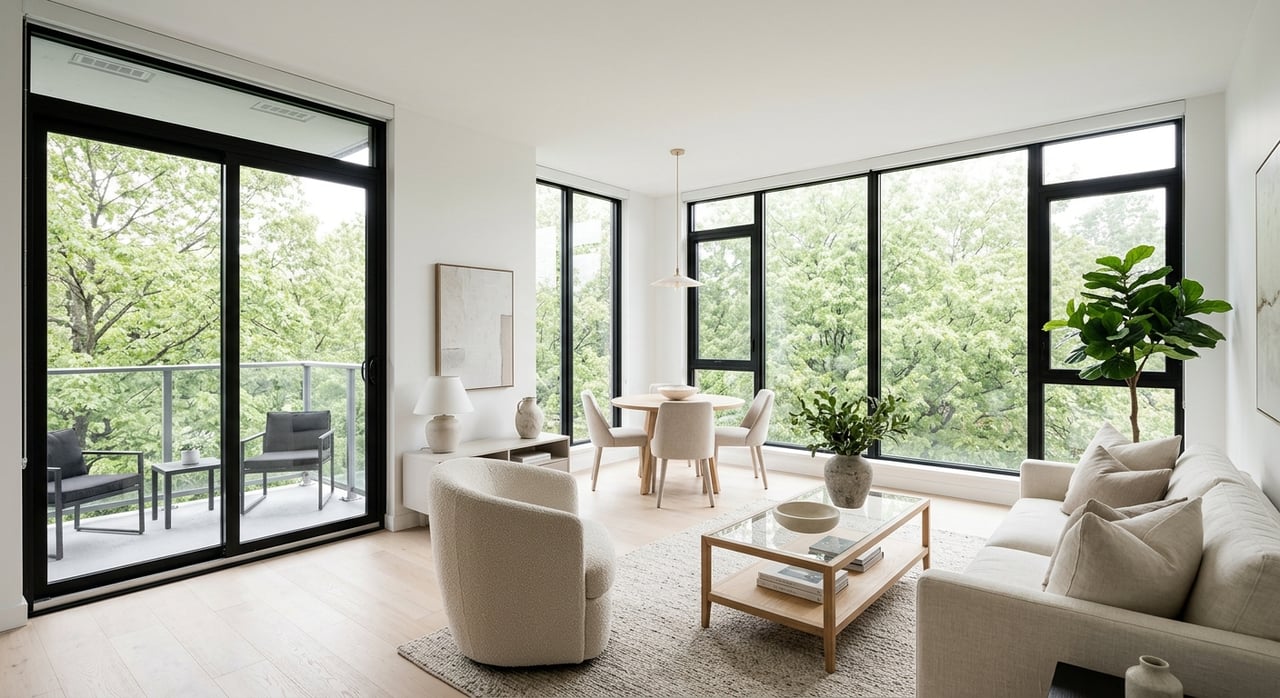
If you want a lower-maintenance lifestyle, a condo may be the easier fit. Many condo buildings are close to Metro stations, restaurants, shops, offices, and trail access, which can make daily life simpler if you prefer to walk, bike, or use transit.
This is especially true in Arlington’s Metro-core nodes. Rosslyn connects to the Orange, Silver, and Blue lines, Ballston-MU serves the Orange and Silver lines, and Pentagon City serves the Blue and Yellow lines. Pentagon is also a major local and commuter bus transit center.
For some buyers, condos also offer a lower price point than detached homes. According to NVAR’s year-end 2025 data, the Arlington condo price figure was $476,832, compared with $1,337,434 for single-family housing. That difference can open doors for buyers who want to be in Arlington without stretching into a detached-home budget.
A condo may have a lower purchase price, but your monthly ownership cost is not just the mortgage. Arlington County’s FY2026 real estate tax rate is $1.033 per $100 of assessed value, and all real property is reassessed annually.
Using the county’s figures, the annual county tax is about $4,926 on a condo assessed at $476,832. That is meaningfully lower than the estimated tax on the average single-family home, but condos often add monthly association dues.
Those dues can range from a few hundred dollars a month to more than $1,000 a month, according to the Consumer Financial Protection Bureau. The same source notes that lenders and buyers should look at association dues as part of the total monthly payment, and that associations may also levy special assessments.
Condo living often works best if convenience is high on your list. In places like Ballston and Pentagon City, WMATA station information shows there is no daily parking at the station, which reinforces how car-light many of these areas are designed to be.
That convenience can come with more activity around you. Near major corridors and station areas, you may notice more traffic, nightlife, and general urban noise than you would in a lower-density neighborhood.
Arlington’s Noise Control Ordinance applies countywide year-round, but the county also notes that condo, apartment, and HOA residents are typically expected to work through property management and community rules first. The county also states that DCA aircraft noise increasingly affects Arlington residents, and Arlington does not control flight paths.
If you want more separation from neighbors, more private outdoor space, or a more traditional ownership structure, a single-family home may be the better match. In Arlington, detached-home neighborhoods often offer a different pace and a different physical setting from the Metro-core condo zones.
You may also prefer the flexibility that comes with owning the structure and land without condo association rules. While every property is different, many buyers are drawn to detached homes because they want more control over how they use and maintain their space.
The biggest barrier for many buyers is price. NVAR’s year-end 2025 charts put Arlington single-family housing at $1,337,434, up 5.3 percent year over year.
Using Arlington County’s FY2026 tax rate, the annual county tax on a home assessed at $1,337,434 is about $13,816. That is a substantial jump from condo-level taxes, even before you factor in the broader costs of maintaining a detached property.
The flip side is that single-family homes usually do not carry condo dues. So while your ownership costs may shift more heavily into the property itself, you are generally not budgeting for condo association dues in the same way.
Detached-home neighborhoods in Arlington often feel quieter internally than Metro-adjacent corridors. If you value a lower-density block pattern, easier at-home storage, or simply a little more breathing room, that can be a meaningful quality-of-life advantage.
That said, quieter does not mean silent. Arlington notes that aircraft noise related to DCA is affecting more residents, and that issue is not limited only to condo areas.
If you are comparing condo and single-family living, it helps to look at the basic ownership math first.
| Housing type | Reference value | Approx. annual county tax |
|---|---|---|
| Condo | $476,832 | $4,926 |
| Single-family home | $1,337,434 | $13,816 |
These figures reflect Arlington County’s FY2026 tax rate and the market values cited in the research. They do not include mortgage payments, insurance, utilities, maintenance, or condo dues and special assessments.
If your routine depends on Metro, buses, biking, or walking, condos in Arlington’s core corridors often have a strong practical edge. Rosslyn, Ballston, Pentagon City, and Pentagon all anchor high-access areas that make it easier to get around without relying on a car for every trip.
That can be especially attractive if you work in D.C., travel often, or simply want to cut down on drive time. Arlington’s transit map also layers in Metrobus, ART, Capital Bikeshare, Zipcar, and commuter resources, which supports a more flexible transportation lifestyle.
In more detached-home neighborhoods, your day may revolve more around driving or combining driving with bus, biking, or trail access. That does not mean these areas are disconnected, but the convenience pattern is usually different from living a few blocks from a Metro station.
For many buyers, this simply comes down to routine. If you want your daily errands and commute to happen on foot or by rail, a condo location may feel more natural. If you care more about home space than station proximity, the tradeoff may be worth it.
If school assignment is part of your decision, Arlington Public Schools says every address is assigned to a neighborhood elementary, middle, and high school. APS also states that the official boundary locator is the tool to verify a specific home’s assignment.
This matters for both condos and single-family homes, but it is especially important with condos because you should not assume the school assignment based on a building name or broader neighborhood label. APS also notes that option schools and programs require a separate application and have limited spaces.
In other words, if schools are part of your planning, verify each address individually before you make assumptions. That step can save you time and prevent surprises.
Recent data suggests single-family homes have shown stronger price momentum than condos in Arlington. NVAR’s year-end 2025 charts show single-family prices up 5.3 percent year over year, while condo prices were up 1.6 percent.
That does not mean condos are a weak choice. In fact, Arlington’s Metro-core markets can offer lower entry pricing and strong liquidity, especially in active, well-located areas.
The story varies by area. Late-2025 pricing snapshots placed Ballston-Virginia Square at $528,245, while Ashton Heights was $1,279,214, Bluemont $1,071,834, Arlington Forest $1,008,757, Waycroft-Woodlawn $1,169,820, Barcroft $918,576, and Glencarlyn $843,516. In Clarendon-Courthouse, Realtor.com’s April 2026 snapshot showed a median sold price of $680,000, up 26.6 percent year over year, with median days on market of 18.
The takeaway is simple: your resale path depends on the exact property, not just the housing type. Building finances, location, condition, and address-specific factors all matter.
You do not need a perfect property type. You need the one that fits how you actually live.
A condo may be the better choice if you want:
A single-family home may be the better choice if you want:
If you are still torn, start with your non-negotiables. Think about your monthly budget, commute style, tolerance for noise, need for space, and how long you expect to stay in the home.
In Arlington, condo and single-family living can both make sense. The best choice usually comes down to matching your home to your routine, your financial comfort zone, and your longer-term plans.
If you want help weighing the tradeoffs in specific Arlington neighborhoods or buildings, Wydler Brothers can help you compare options with clear, local guidance.
Stay up to date on the latest real estate trends.

The national market is anything but uniform. Here's where Washington fits in.
A Realtor's Guide to Moving

Why High Mortgage Rates, Low Inventory, and Frozen Housing Mobility Continue to Restrain the DC Housing Market

How to Rethink Your Home, Lifestyle, and Future in the Empty Nest Phase

Twenty-one years ago, Steve and I wrote our first Washington Post article titled “Bigger Bids Aren’t Always Better Bids.”
Much has been written about the coming “Silver Tsunami” — the unprecedented wave of wealth transferring from Baby Boomers to younger generations. But from where we sit… Read more

As we look forward to this new year and enter a new housing market era, Steve and Hans have tackled 15 of the most common real-estate myths they see in the market.

Compass Corporate has released their 2026 Market Outlook, and a handful of insights stood out as especially telling. Here is what caught our attention.

Valuing and negotiating a home can feel a lot like blackjack. You need skill, instinct, and some luck—and the stakes are real.
Wydler Brothers have been selling residential real estate for over 20 years in the DC metro area. Along the way, they’ve achieved numerous awards and recognitions, including being recognized as “The Most Innovative Real Estate Agent in America” (Inman, 2014), written several articles for The Washington Post, authored a book, “Inside the Sell”, co-founded a real estate tech company which sold to Move, Inc. in 2013, and built Wydler Brothers into a highly respected boutique brokerage with 70 agents and employees which they sold to Compass in 2019. Currently, Wydler Brothers is among the top 3 teams in the DMV and was the #1 Compass Team in 2022.